

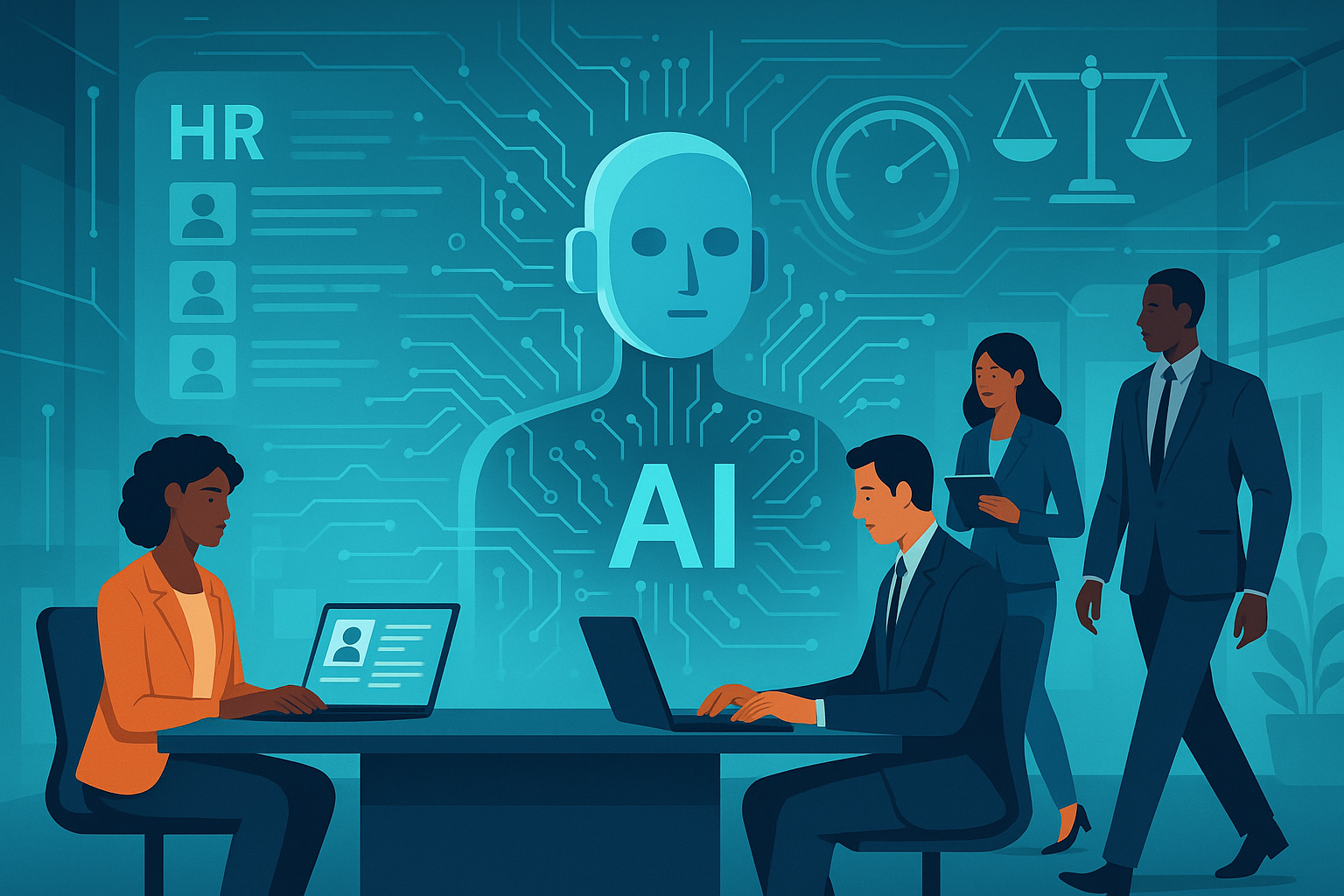
The Role of AI in Modern HR Management: Smarter, Faster, Fairer
In today’s rapidly evolving business landscape, Human Resources (HR) is no longer just about filing leave forms and managing payroll. It’s becoming a strategic cornerstone — and nowhere is this more evident than in the UAE, where diverse workforces, regulatory complexity, and digital-transformation pressures collide. At Decibel360 Cloud, we believe the future lies in smarter, faster, and fairer HR — and artificial intelligence (AI) is the key enabler of that transformation.
Let’s explore how AI is reshaping HR management, why it matters for organizations in the UAE and the Gulf region, and how HR leaders can harness it responsibly to drive outcomes.
Why AI Matters for HR Today
The impetus for change
HR teams are under more pressure than ever to deliver value: to hire and retain talent, adapt to new working models (hybrid, remote), ensure compliance across jurisdictions, drive engagement and performance — while optimizing cost and efficiency.
AI steps in as a force multiplier: enabling automation of routine tasks, insightful analytics, and even predictive capability. According to a recent report, 43 % of organizations now leverage AI in HR tasks, up from 26 % in 2024.
A strategic shift
Rather than HR being primarily an administrative cost-center, AI enables it to become a strategic business partner — helping anticipate talent needs, detect risks early, personalize employee experiences, and optimize workforce planning. As one insight puts it: “HR is about humans, but balancing the needs of humans with the need to drive business forward isn’t always easy… HR teams are finding the help they need in AI.”
For the UAE context
In the UAE and Gulf region, where companies often operate across multiple emirates, involve expatriate workforces, and face regulatory changes (labour law, visas, payroll variants), the need for agility and accuracy is particularly strong. A robust HCM like Decibel360 Cloud can provide the backbone — and AI adds the intelligence.
How AI Enables “Smarter, Faster, Fairer” HR
Let’s break this down into the three pillars: Smarter, Faster, and Fairer.
Smarter — Insight, Strategy, Prediction
- Analytics & predictive HR: AI enables real-time dashboards, predictive modelling (e.g., attrition risk, talent gaps, performance trends). Emerging stats suggest AI-powered HR analytics can forecast workforce trends with ~90 % accuracy.
- Talent acquisition optimization: AI tools can screen and match CVs, assess job/cultural fit, even predict which candidates will succeed. This means smarter hiring decisions, not just faster ones.
- Employee experience personalization: AI can help tailor learning & development paths, benefit offerings, internal mobility opportunities — matching individual profiles and preferences. According to recent insights, by 2025 around 80% of employees will expect personalized AI‐driven career development plans.
- Strategic workforce planning: AI helps answer questions such as: “Given our business goals, what skills will we need in 12-24 months?”; “Which roles are at risk of attrition?”; “Where should we invest in upskilling?” This frees HR from reactive firefighting to proactive planning.
Faster — Efficiency, Automation, Agility
- Automating routine HR processes: Leave requests, expense reimbursements, onboarding paperwork, payroll validations — these are increasingly handled by intelligent workflows. This reduces human error and frees HR to focus on higher-value work.
- Speeding up hiring and onboarding: Some studies show AI screening tools can reduce time-to-hire by 30-50 %.
- Improved responsiveness: In Decibel360’s platform, modules like HR Help Desk, real-time analytics, self-service portals mean HR can respond faster to employee needs, managers can get answers quickly, and the organization moves with agility.
- Time to value: The faster HR achieves operational excellence (e.g., onboarding, performance measurement), the quicker the organization benefits — especially in dynamic markets like the UAE.
Fairer — Equity, Transparency, Experience
- Reducing bias in hiring and promotion: AI can help by applying consistent criteria, focusing on competencies and data rather than subjective impressions. For example, one set of data estimates that AI hiring tools could reduce recruitment bias by ~50% by 2025.
- Equalizing employee experiences: Personalized career paths, targeted talent development, data-driven recognition — all contribute to more fair and inclusive workforce practices.
- Embedding transparency and ethics: Fair AI means being clear about how data is used, how decisions are made, providing employee’s visibility and recourse. Studies show that employee trust improves when AI systems are transparent.
- Better experience for all: When HR becomes smoother, less cumbersome, and more value-adding, employees perceive the function as more fair and supportive rather than punitive or bureaucratic.
Key AI Use Cases in Modern HR
Here are concrete examples of how AI is being applied in HR — with relevance to a sophisticated HCM like Decibel360 Cloud.
| Use Case | Description | Value |
| CV screening & candidate matching | AI scans applications, matches job requirements, predicts best fit | Faster hiring, reduced workload, improved talent fit |
| Onboarding automation | AI guides new joiners through forms, training path, first-90-day support | Better new hire experience, faster ramp-up |
| Performance & potential analytics | AI tracks performance data, identifies high-potential employees, predicts risk of attrition | Strategic talent development, retention |
| Employee sentiment & engagement | AI analyses survey/text data, flags disengagement or concerns | Proactive intervention, more engaged workforce |
| Learning & development recommendations | Recommendation engine suggests courses, micro-learning, internal mobility | Better skills alignment, employee growth |
| Payroll & benefit optimization | AI checks compliance, optimizes benefit uptake, flags anomalies | Accuracy, cost-efficiency, fairness |
| Workforce planning & scheduling | AI forecasts demand, aligns shifts, predicts uses — especially relevant in sectors like retail, hospitality which are big in UAE | Cost control, agility |
These use-cases demonstrate how HR becomes smarter through insights, faster through automation/efficiency and fairer through equity and transparency.
Challenges & How to Navigate Them
While the potential is significant, adopting AI in HR is not without its challenges — and a responsible approach is essential.
Common Challenges
- Data quality & integration: AI is only as good as the data it uses. Poor data governance, fragmented systems, inconsistent records hamper effectiveness.
- Human-machine overlay: HR is fundamentally about humans – culture, emotions, judgement. Over-automation or losing the human touch risks disengagement. Research highlights concerns over “quiet cracking” — where employees appear engaged but internally struggle, and AI systems may misclassify or miss such subtleties.
- Bias, transparency & trust: AI models can embed bias if the training data is skewed. Employees may mistrust decisions made by “black box” AI. Studies show governance and exploitability matter.
- Skills and culture: HR teams need to become AI-literate. Without capability and mindset, tools won’t deliver.
- Changing regulations & ethics: Particularly in the UAE & GCC, data privacy, labour law, localisation requirements may impact implementation.
- Change management & adoption: Employees and managers must buy into new ways of working; resistance or lack of adoption undermines value.
How to Navigate Successfully
- Start with clear strategy & use‐cases: Identify what “smarter, faster, fairer” means for your organisation. Pick high-impact, manageable use-cases.
- Ensure clean, integrated data and analytics foundation: A unified HCM like Decibel360 helps centralise data.
- Combine AI with human oversight: Use AI to augment decisions, not replace humans. Ensure HR professionals set the policy, interpret insights, and act with empathy.
- Focus on transparency & employee experience: Be open about how AI is used; provide feedback loops; monitor how employees perceive and engage with the AI.
- Invest in upskilling HR & leadership: Build awareness, establish governance frameworks, train teams to leverage insights effectively.
- Pilot, measure, scale: Begin small, measure results (efficiency gains, engagement shifts, bias reduction), then scale thoughtfully.
- Localise for region: In UAE/GCC context, ensure compliance with regional regulatory & cultural realities; multinational firms must handle multi-jurisdiction complexity.
What This Means for HR Leaders in the UAE
For HR leaders operating in the UAE — whether in large enterprises, mid-sized organizations or startups — the direction is clear: AI is not optional; it is increasingly business-critical.
Here are key takeaways:
- Be proactive: Don’t wait for AI adoption to become a competitive necessity. Begin your journey now.
- Advantage partner platforms: Choose an HCM that supports AI-enabled modules (analytics, talent management, automation) — like Decibel360 Cloud’s unified platform.
- Focus on value, not hype: It’s easy to be distracted by buzzwords (chatbots, generative AI, etc). Anchor your implementation in concrete business outcomes: time to hire, cost per hire, turnover rate, talent pool depth, employee experience.
- Embed fairness and trust: In a diverse environment like the UAE (multiple nationalities, skill levels, cultural backgrounds), fairness is particularly important. Use AI to support inclusive practices.
- Make HR strategic: When routine work is automated, HR can become a strategic partner — advising leadership on workforce decisions, culture development, capability building.
- Monitor & iterate: Use AI-powered insights to continuously refine your HR model: “What’s working?”, “Where are the gaps?”, “How is the employee sentiment evolving?”
Looking Ahead: The Future of HR Powered by AI
As we head further into 2025 and beyond, a few emerging themes are worth keeping an eye on:
- Generative AI in HR: From drafting job descriptions and performance feedback, to conversing with employees via HR chatbots — the frontier is shifting from predictive to generative.
- Human-AI collaboration: The “co-pilot” model where HR professionals partner with AI tools rather than being replaced by them.
- Hyper-personalized employee experiences: Driven by AI, each employee’s journey – from onboarding through career path – will become more tailored.
- Ethics, governance and AI literacy: These will become differentiators. Organizations that manage AI responsibly will have a competitive advantage.
- Measurement of HR’s strategic impact: AI will enable more precise measurement of how HR contributes to business outcomes — profitability, productivity, agility.
- Regional adaptation & regulatory alignment: In the Gulf region, expect more nuance around workforce nationalization, expatriate employment models, remote/hybrid working norms — and HR systems must adapt.
Conclusion
In summary: the role of AI in modern HR isn’t about replacing people — it’s about enhancing HR’s ability to deliver value: smarter insights, faster operations, fairer practices. For organizations in the UAE — facing complexity, cost pressure, talent challenges — this transformation is particularly relevant.
At Decibel360 Cloud, we’re committed to enabling this transformation: helping HR teams move beyond paperwork into strategic partnership, enabling workforce excellence, improving employee experience and driving business outcomes.
If you’re ready to explore how AI-enabled HR can drive impact in your organization — we’re here to partner with you.
Call to Action: Interested in seeing how AI-driven HR looks in practice? Contact us for a demo and see how Decibel360 Cloud can make your HR smarter, faster and fairer.